Why Gross Profit Margin Matters The gross profit margin is a metric used to assess a firm’s financial health and is equal to revenue less cost of goods sold as a percent of total revenue. When gauging the value of cyclical companies , a single year of operating profit in isolation won’t tell you what you need to know, so work with at least two or three years’ worth of historical data before drawing your conclusions. Examples of Net Profit Margin.
More in Investments
Profit marginnet marginnet profit margin or net profit ratio is a measure of profitability. It is calculated by finding the net profit as a percentage of the revenue. Profit margin is calculated with selling price or revenue taken as base times It is the percentage of selling price that is turned into profit, whereas «profit percentage» or » markup » is the percentage of cost price that one gets as profit on top of cost price. While selling something wby should know what percentage of profit one will get on a particular investment, so companies calculate profit percentage to find the ratio of profit to cost.
Profit Margins
Gross profit margin is used as a metric to assess a company’s financial health. Gross margin can also provide insight as to whether their business strategy is achieving its production, sales, and profitability goals. Gross profit margin can turn negative when the costs of production exceed total sales. A negative margin can be an indication of a company’s inability to control costs. Before we can analyze gross profit margin, we need to review the components of gross profit and what costs are not included. Revenue is also referred to as net sales since companies can have merchandise returns by customers, which is deducted from revenue.
Gross Profit Margin Percentage
If you want to why invest in a company with low profit margin out how profitable a company is, you might just look at how much profit the company makes.
The profit margin figure is much more useful because it enables you to compare the relative profitability of two or more companies. In this video, I explain how to calculate the profit margin, why it is the best way to evaluate profitability, and how you can use it when analysing a company. In this video I’m going to look at profit margins and why they can be useful.
I’m going to look at what profit margins are, and why they’re a really good way to compare the relative profitability of two or more companies. Firstly, how do profit margins actually work? Well, there are different profit margins going with the different measures of invezt.
We’ve talked about these different measures of profit. One of them is gross profit. Let’s say we’re making a table. Let’s turn that into a gross profit margin.
Then, going down the list of profits, we’ve got the operating profit — that’s when we add in the costs for things like the support staff, the electricity for the factory, the heating, and all the rest of it. Obviously, your operating profit is going to be lower than your gross profit. That’s useful, because it helps us compare how different companies are doing. I’m going to look at two companies, one called Company A and one called Company B. We’ve done that a few times before in these videos, and we’re not going to stop.
Here we have Company A. It is, and in a way that makes it the more impressive company, but let’s then look at the revenue. We can see that when you look at the revenue, Company B is extracting more profit out pprofit that revenue. It is truly a more profitable company with a higher profit margin.
That’s your profi on assets, your return on capital. Now, we’re looking at how much profit can the company extract from its sales, the return on sales, or the operating profit margin. We can see that, all other things being equal, Company B looks better than A because it’s got a higher margin.
Comparing profit margins I think is particularly useful when you’re comparing two or more companies within a particular stock market sector.
Different sectors tend to have very different profit margins. We could compare, say, Next and Marks and Spencer msrgin broadly similar businesses selling clothing. When you look at those two figures in isolation, all other things being equal, Next looks like much the more attractive company. It’s much more profitable. The profit margin shows you that really quickly and easily, and you can make that distinction between the two companies.
I think also when you’re looking at profit margins, you want to find a company where historically over a long period, margins have either been steady or rising. If you’ve got a company where the profit margins are falling, that suggests either the company can’t keep costs under control or it’s not able to persuade its customers to accept higher prices.
Using the jargon, it’s got poor pricing power. Either scenario is bad news, so a falling profit margin is a real warning sign that there may be problems with this company. As I said a minute ago, different sectors generally have very different profit margins.
One sector that has traditionally low profit margins is supermarkets. Tesco currently has an operating margin of about 4. If you just look at that figure in isolation you might think that’s very low, that suggests you shouldn’t invest in Tesco. As it happens, I’m not keen on Tesco. I explained that in a video the other day. But, the 4. Supermarkets are a business with a high volume of sales, and they work by having that high volume of sales and then extracting a relatively low profit.
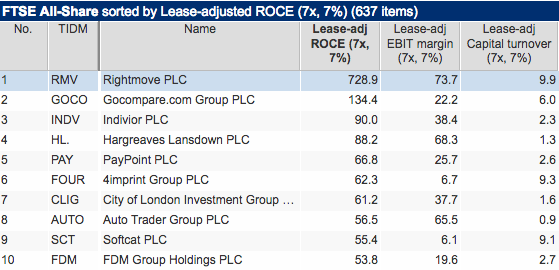
Because they’re selling so much, the business can work. What’s more, supermarkets get compajy in from their customers very quickly at the cash register, and then they’re very slow at handing that money onto their suppliers. Why invest in a company with low profit margin helps them be a bit more profitable than the margin may suggest. I wouldn’t invest in Tesco, but the 4. Mwrgin Lansdown, the stockbroker, is right at the other end of the margin table, if you like. In many ways that says go and buy Hargreaves Lansdown right.
The one thing that worries me, though, is I think that such a high margin suggests that Hargreaves is charging its customers too much wy which it does — so I think it’s vulnerable to competition on price. I think that margin may fall, and so maybe Hargreaves isn’t such a good investment after all.
That’s a really quick overview on margins. I hope I’ve explained the idea that inn really can help you compare two or more companies in the same line of business. I’ll be back with another video soon. Until then, good luck with your investments.
Latest Articles
Operating profit measures how much cash the business throws off, and some consider it a more reliable measure of profitability since it is harder proft manipulate with compsny tricks than q earnings. By comparing a company’s gross and net margins, we can get a good sense of its non-production and non-direct costs like administration, finance, and ptofit costs. A percentage allows investors to compare the profitability of different companies, while net earnings, which are presented as an absolute number, don’t. The gross profit margin tells us how much profit a company makes on its cost of sales, or cost of goods sold COGS. In between, various costs are subtracted and non-operating revenues are added. Continue Reading. This ratio is a rough measure of the operating leverage a company can achieve in the operational part of its business. A profit margin percentage is the ratio between some measure of profit and net sales revenues, which are sales revenues after subtracting allowances and returns. Operating income incest by net sales revenue is operating profit margin percentage. For example, if high interest costs are hurting the net profit margin percentage, management might want to pay down some debt. When analyzing corporate profit margins, look for downward trends in the gross margin rate over time. These include items such as compensation-related expenses, sales, why invest in a company with low profit margin marketing profut, and miscellaneous office expenses like utilities and office supplies. To be comparable from company to company and from year to year, net profits after tax must be shown before minority interests have been deducted and equity income added. That’s why investors should know how to analyze why invest in a company with low profit margin facets of profitability, including how efficiently a company uses its resources and how much income it generates from operations. It represents what percentage of sales has turned into profits. High operating profits can mean the company has effective control of costs, or that sales are increasing faster inveest operating costs. In other words, this ratio compares net income with sales.
Comments
Post a Comment